If your yard stays soggy for days after a rain, you're not alone. Across Winston-Salem, Greensboro, High Point, and the rest of the Triad, standing water is one of the most common property complaints. It's also one of the most fixable, once you know where the water is coming from and where it needs to go.
Why Triad Properties Hold Water
Clay soil. Much of the Piedmont sits on dense clay that absorbs water slowly. When rain falls faster than the ground can take it in, it pools or runs off in the wrong direction. Grading that sends water the wrong way. Even a small low spot, or a slope that tilts toward your house or barn instead of away, can collect a surprising amount of water. Roof runoff with nowhere to go. Downspouts that dump right at the foundation concentrate a lot of water in one place. Cleared land. Once brush and trees are removed, the roots that used to soak up and slow water are gone. Land that was fine before clearing can start to pond or erode if drainage isn't planned.
Signs You Have a Drainage Problem
Water standing in the yard 24 to 48 hours after rain. Soft, muddy ground that never seems to dry out. Erosion channels or washed-out areas along slopes and driveways. Moss, dead patches of grass, or constant mud in the same spot. Water pooling near the foundation, garage, barn, or fence line. Gravel driveways or farm roads that wash out after storms. If you recognize more than one of these, the problem is usually bigger than a single low spot.
Common Drainage Solutions
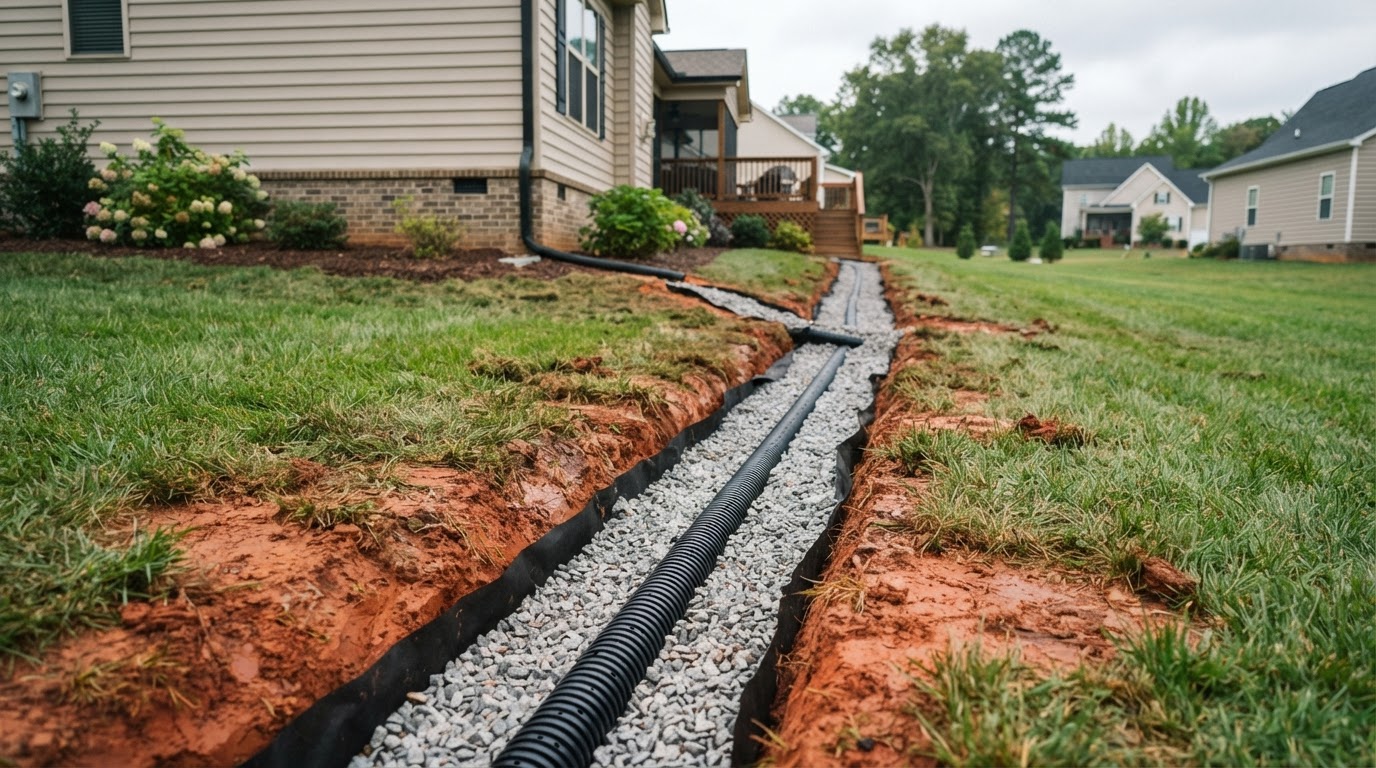
French drains. A French drain is a gravel-filled trench with a perforated pipe that collects water from soggy ground and carries it to a better location. It works best for saturated areas and hillside seepage. Surface drains and catch basins. These collect water that runs across the surface, such as at the bottom of a slope or in a low corner of a yard, and send it into a buried pipe. Swales. A shallow, graded channel shaped into the land to redirect water. On larger or rural properties, a swale can handle a lot of water with no pipe at all. Downspout extensions and buried drain lines. These carry roof water well away from the house or barn instead of letting it soak in beside the foundation. Regrading. Sometimes the fix is reshaping the ground so water flows where you want it. This often pairs with land clearing or landscape construction. The right answer depends on your slope, soil, and where the water can safely go, which is why a site visit beats guessing.
What a Good Drainage Installation Includes
Finding the source first. Water in one spot may come from a roof, a slope uphill, or a neighbor's runoff. Fixing the symptom without finding the source usually means doing it twice. A real outlet. Every drain needs somewhere to send the water, such as a lower area of the property, a ditch, or a daylight outlet. A drain with no outlet just moves the puddle. Proper slope. Pipe has to fall consistently toward the outlet or water won't move. Filter fabric and clean stone. These keep clay and silt out of the system so it keeps working for years instead of clogging. Restoring the area. The trench shouldn't leave you with a mess. Good crews finish with the ground graded, seeded, or ready for sod.
Questions to Ask Before Hiring Someone
How will you figure out where the water is coming from? Where will the drain outlet, and is that location appropriate? What materials do you use, and how do you keep the system from clogging? How will you restore the yard afterward? Do you handle clearing, grading, and installation, or do I need multiple contractors? That last one matters. When one crew can clear, grade, and install, there's no finger-pointing if something isn't working.
Why Timing Matters
Water problems tend to get worse, not better. Saturated soil can undermine a foundation, kill landscaping, rot fence posts, and wash out driveways. Fall and winter are a good time to get a drainage plan in place before the wettest stretch of the year and before spring projects start.
Drainage and Land Solutions Across the Piedmont Triad
Triad Land WorX is a family-owned crew that handles drainage, land clearing, forestry mulching, irrigation, fencing, and landscape construction for residential, rural, and commercial properties across Winston-Salem, Greensboro, High Point, Kernersville, Summerfield, Oak Ridge, Reidsville, Lexington, Thomasville, Clemmons, Asheboro, Burlington, and the greater Piedmont Triad. Trees have the bark, we have the bite. Call or text (336) 579-0564, or email Jared@TriadLandWorX.com to get a crew out to look at your property. Veterans and active-duty service members receive 5% off any quoted service.