If you live in Greensboro, Winston-Salem, or anywhere in the Piedmont Triad, you know the problem: a hard rain turns your yard into a swamp. The culprit isn't bad luck — it's the clay soil that sits under most of our region. Here's why French drains are the permanent fix, and why we engineer every one specifically for North Carolina clay.
Why Triad Clay Soil Drains So Slowly
The Piedmont Triad sits on heavy red clay that holds water like a sponge. When it rains, the water has nowhere to go — it pools on the surface, saturates the top few inches, and slowly seeps toward the lowest point. That means soggy lawns, standing water that kills grass, and water pushing against your foundation. The clay doesn't drain on its own, so you have to give the water a path out.
How a French Drain Works
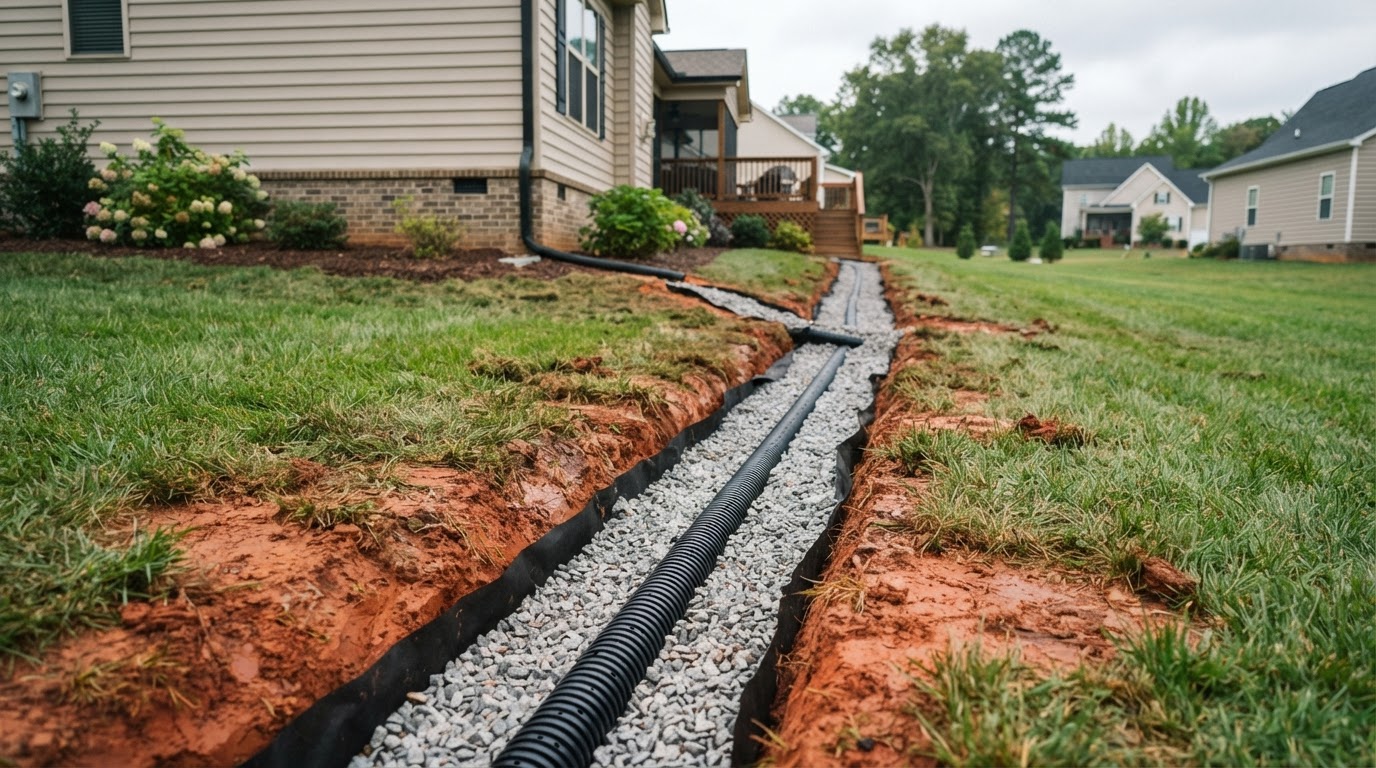
A French drain is a trench filled with gravel and a perforated pipe. Water flows into the trench, enters the pipe through the perforations, and is carried away from your yard to a safe discharge point. The gravel lets water in fast; the pipe moves it out fast. When it's laser-graded correctly, a French drain can move hundreds of gallons per hour away from your foundation and lawn.
Why Installation Quality Matters
A French drain only works if it's graded precisely and installed at the right depth. We use laser-guided mini excavators to cut trenches at the exact slope needed for water flow — not a guess, a measurement. We wrap the pipe in filter fabric so clay particles don't clog the perforations, and we backfill with clean stone so water enters freely. Skip any of these steps and your drain fails within a year.
Signs You Need a French Drain
Standing water in your yard 24+ hours after rain, a soggy or mushy lawn, water in your basement or crawlspace, erosion channels forming in your yard, or a musty smell near your foundation. If any of these sound familiar, a French drain will likely solve it permanently. Most installations take just 1-2 days and leave your yard dry and usable.