A good patio can turn an unused corner of your yard into the place everyone ends up on a summer evening. But a hardscape is only as good as what's under it. Across Winston-Salem, Greensboro, High Point, and the rest of the Triad, we see the same thing again and again: patios that look great the first year and then sink, shift, or pool water because the base was an afterthought. Here's how to plan one that holds up.
What Is Hardscaping?
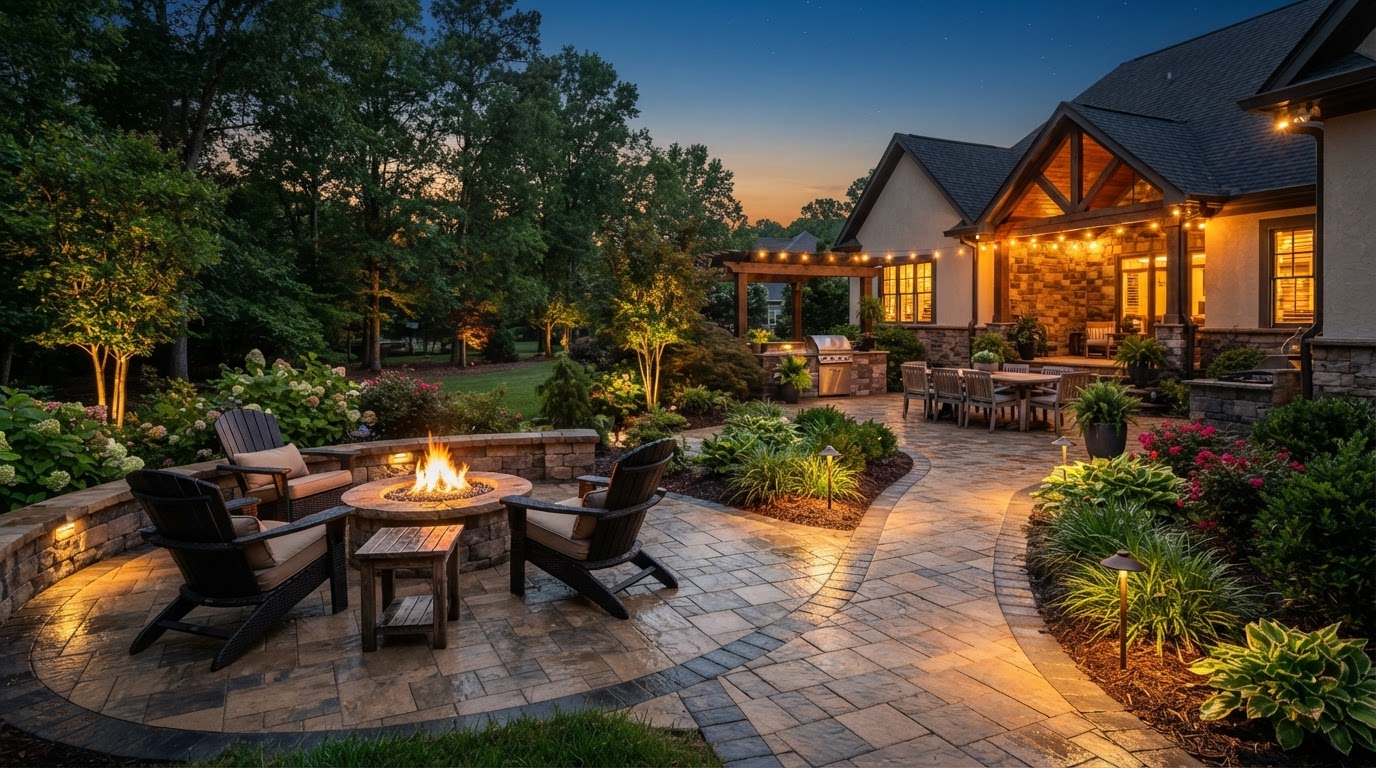
Hardscaping is the non-living part of your landscape: patios, walkways, retaining walls, fire pit areas, steps, and the lighting that makes them usable after dark. Done well, it gives your yard structure and gives you more places to actually use.
Why the Base Matters Most in the Triad
Clay soil. Much of the Piedmont sits on dense red clay. It holds water, swells when it's wet, and shrinks when it dries. A paver patio set straight on clay, or on a thin base, will move over time. Water has to go somewhere. A patio is a hard surface that doesn't absorb rain, so if the ground under and around it isn't graded to carry water away, you end up with puddles, washed-out joints, or water running toward your house. Freeze and thaw. Winters here are milder than in the mountains, but the ground still freezes and thaws, and repeated cycles will find any weakness in poor prep. The fix is the same in each case: proper excavation, a compacted gravel base, and grading planned before a single paver goes down. If your yard already holds water after rain, it's worth addressing the drainage first.
Patio Materials: Pavers vs. Poured Concrete vs. Natural Stone
Concrete pavers. Interlocking pavers come in many shapes, colors, and patterns. They flex slightly with the ground, individual pieces can be replaced if one is damaged, and they hold up well when installed correctly. Poured concrete. Concrete is a solid, lower-profile option, but it can crack as clay soil moves and is harder to repair invisibly. Natural stone. Flagstone and similar materials give a distinct, natural look. They take more skill to install, and the cost and look vary a lot with the stone. Which one fits depends on your yard, your budget, and the style you want.
What a Quality Paver Installation Includes
Layout and planning — marking the shape, checking slope, and deciding where water will go before digging. Excavation — removing enough soil to fit a full base and the pavers at the right final height. Compacted gravel base — installed in layers and compacted; this is the foundation of the whole job. Bedding layer — a level layer of sand the pavers sit in. Edge restraints — a firm border that keeps pavers from spreading apart over time. Joint sand — sand swept into the gaps to lock the pavers together and help keep weeds out. If a contractor can't walk you through the base, be cautious. It's the part you can't see and the part that matters most.
Outdoor Lighting: More Than Just Ambiance
Lighting extends how long you can use your outdoor space, and it also makes the property safer and more welcoming. Common options include path and walkway lights to guide people safely along steps and walks; step and wall lights built into hardscape features; accent lighting to highlight trees, planting beds, and architecture; and patio and seating area lighting for evenings and entertaining. Planning lighting alongside the patio, rather than after, makes it much easier to run wiring cleanly and place fixtures where they belong.
Plan for the Whole Property
A patio works best when it's designed with the rest of the yard in mind. Think about drainage — where will water go during heavy rain? Irrigation — sprinkler lines and heads should be planned around hard surfaces, not through them. Access — make sure you have a safe path to and from the patio. Sun and shade — where is the space comfortable in July? And future projects — if you might add a fire pit, a retaining wall, or an outdoor kitchen later, leave room for it now. Because we handle land clearing, grading, drainage, irrigation, and hardscape, we can plan these pieces together instead of working around each other.
Questions to Ask Before Hiring a Hardscape Contractor
How deep will you excavate, and what does the base consist of? How will you handle drainage around the patio? What edge restraint do you use? Can you show me examples of previous work? What warranty or workmanship guarantee do you offer? Will you coordinate with irrigation and lighting? A contractor who can answer these clearly has probably built patios that held up.
When to Build
In the Triad, hardscape work can happen most of the year. Spring and fall are popular because the weather is comfortable, so booking ahead helps. If you want your patio ready for next season, planning in the off-season is a smart move.
Planning a Patio or Hardscape in the Piedmont Triad?
Triad Land WorX is a family-owned landscape construction company serving Winston-Salem, Greensboro, High Point, Kernersville, Summerfield, Oak Ridge, Reidsville, Lexington, Thomasville, Clemmons, Asheboro, Burlington, and the greater Piedmont Triad. Tell us what you have in mind and we'll walk you through the options for your property. Trees have the bark, we have the bite. Call or text (336) 510-8900 or email Jared@TriadLandWorX.com. Hours: Monday to Saturday, 7 AM to 8 PM. Veterans and active-duty military receive 5% off any quoted service.